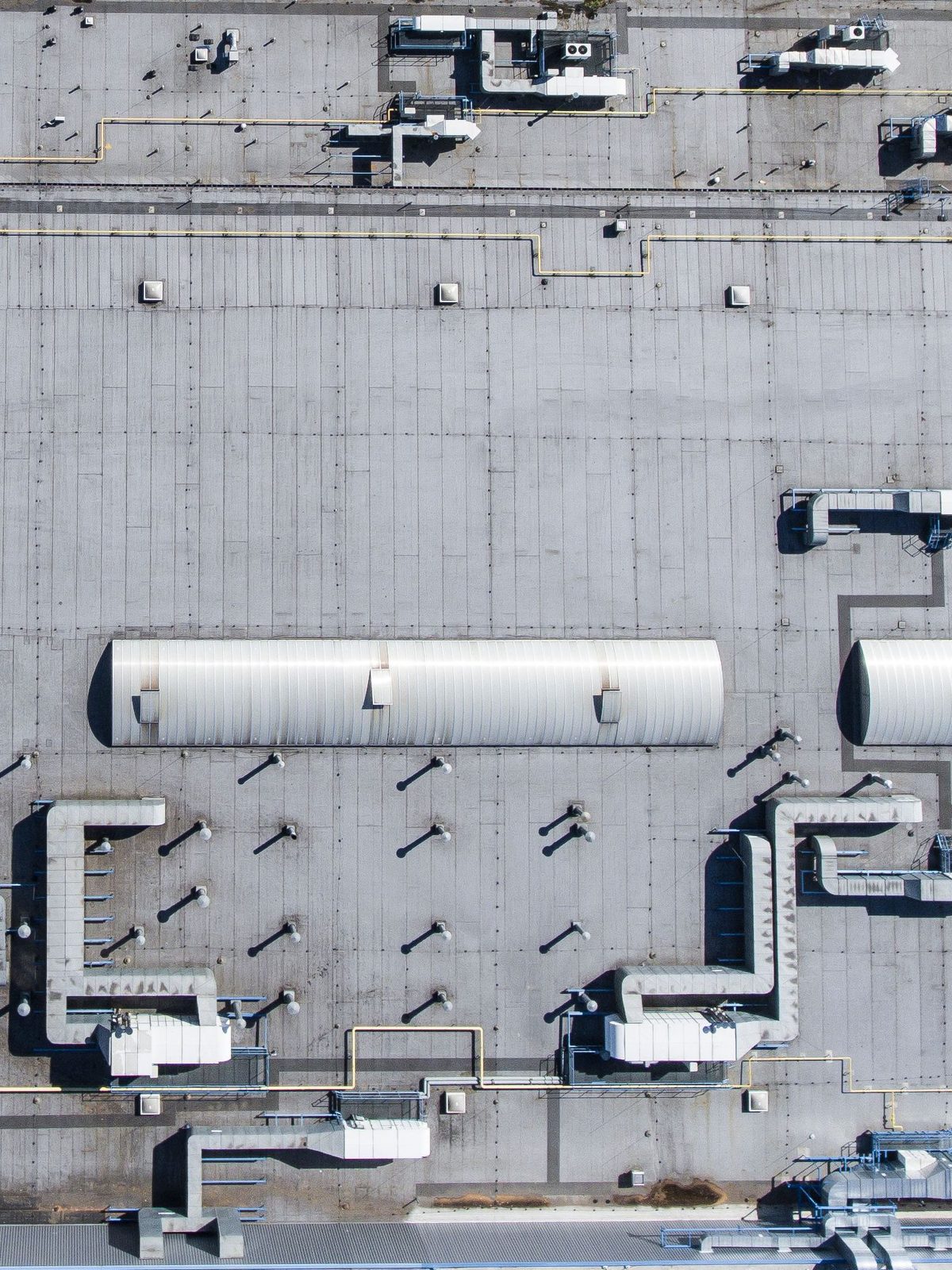
What the document has to do
A commercial roof inspection for insurance purposes has one job: to describe the roofs on a building accurately, on a known date, in a way somebody outside your organization can read and rely on. That reader might be a broker, a carrier, a lender, an owner or the person who takes your job in two years. None of them will ever stand on the roof.
So the document is built around locating things. A finding that cannot be found again is not evidence, and a photograph nobody can place on a building is a picture. Every defect gets a number, a description, a position on a plan and a dated image, and every roof area is described separately rather than averaged into one line about the building.
The other half of the job is stating the limits. What was walked, what was viewed from a distance, what could not be reached and why. A report that quietly covers a roof it never got onto is the one that causes trouble later, and the trouble lands on whoever handed it over.
What we do and what we stay out of
We inspect and document roofs. We do not sell insurance, we do not advise on cover and we do not decide claims. Your policy document and your carrier govern what your cover does. Nothing in the report, and nothing said on site, is an opinion about your policy, your broker’s advice or anybody’s decision.
That line is worth holding for a practical reason as well as an honest one. A condition record is credible to a reader because it describes a roof and stops. A document that argues a position invites the reader to discount everything in it, including the plain observations that were the point of commissioning it.
So wear is recorded as wear. Damage is described and located. Where a cause cannot be established from what is visible, the report says so rather than choosing the explanation that suits anybody.
When managers book it
Usually when somebody asks: a renewal, an application, a lender’s condition, a landlord’s requirement, a new manager inheriting buildings nobody has looked at. Sometimes after work, to record the state a roof was left in.
The better version is a program rather than a response. Buildings inspected on a cycle, in one format, with findings carried forward, produce a file that shows roofs being maintained rather than roofs being photographed the week somebody asked. That file is also the only way to catch the roof that is deteriorating quietly, which on most portfolios is not the one anybody is worried about.
Common questions
Who should we ask about what the report has to contain?
Whoever asked you for it. That is not evasion, it is the only reliable route, because a carrier, a broker, a lender, a landlord and a managing agent each want something different.
- Some want particular headings, some want photographs of specific details
- Some want the roof described in their own terms
- Some simply want a current, dated document from a contractor
- Ask them, get the answer in writing, and send it to us before the visit
- Where their list is reasonable and the roof supports it, we write to it
Where something on the list cannot be established honestly from an inspection, we complete it as an estimate and say so, or explain why it is left open. We will not predict what they will accept, because we inspect and document roofs, we do not advise on cover and we do not decide claims.
Can you inspect several buildings at once?
Yes, and for a portfolio it is the sensible way to do it. The advantage is not only scheduling.
- Every building is described the same way, by the same people, in the same format
- Against the same rating scale, so you can lay them side by side
- Reports by different contractors in different years cannot be compared
- Buildings close together can often be done in a run of days
- Sites spread out are usually scheduled over a period
Decide the order deliberately, oldest roofs and known problems first, so the useful information arrives early rather than alphabetically. You get one document per building and, where it helps, a short summary across the portfolio showing which areas need attention now, which is a planning tool rather than a claim about any building.
Do you need to disturb the tenants?
Rarely, but it depends on how the roof is reached. The work happens above people rather than among them, so on most buildings a tenant sees somebody cross a corridor to a ladder.
- Access is where it does affect them
- If the route runs through a leased area or a plant room, we need the keyholder
- If your leases set a notice period, we work to it
- Some buildings require a permit, a sign in or an escort to reach a hatch
- That usually decides the date rather than our diary
Where a section sits over a quiet area and water testing is involved, we agree beforehand what gets covered and who moves it. Work outside normal hours is possible where a building demands it, and it adds cost, so treat it as a decision at booking rather than a surprise on the invoice.
Can the inspection be repeated every year in the same format?
Yes, and that is where most of the value in commercial reporting sits. A single report describes a roof on one day, while a run of them describes a direction.
- A direction is what a budget and a maintenance program actually need
- The second visit repeats the first: same boundaries, same plan, same rating scale
- Photographs from recorded positions, and previous findings carried forward
- Each finding ends up as repaired, unchanged, worse or new
- That summary page is short and tells you more than either report alone
It shows which defects are moving and which repairs did not hold, and it shows a roof being looked after in dated documents, which is a record impossible to assemble retrospectively. What that record does for anything outside roofing is not something we will guess at.
Will you deal with the carrier or the adjuster?
No. We inspect the roof, we write down what we found, and we give the document to you.
- We do not sell insurance, advise on cover or decide claims
- We do not act for a carrier or against one
- Your policy document and your carrier govern what happens with any report
- Name an address and we will send a copy there, as a delivery not a conversation
- A technical question about the roof we answer in writing, with you copied in
What an image shows or how a detail is built is a roofing question and fair to put to us. Anything about cover, values, terms or what should happen next goes back to you, and from you to your broker, agent or carrier, because the report is written to be read without us in the room.